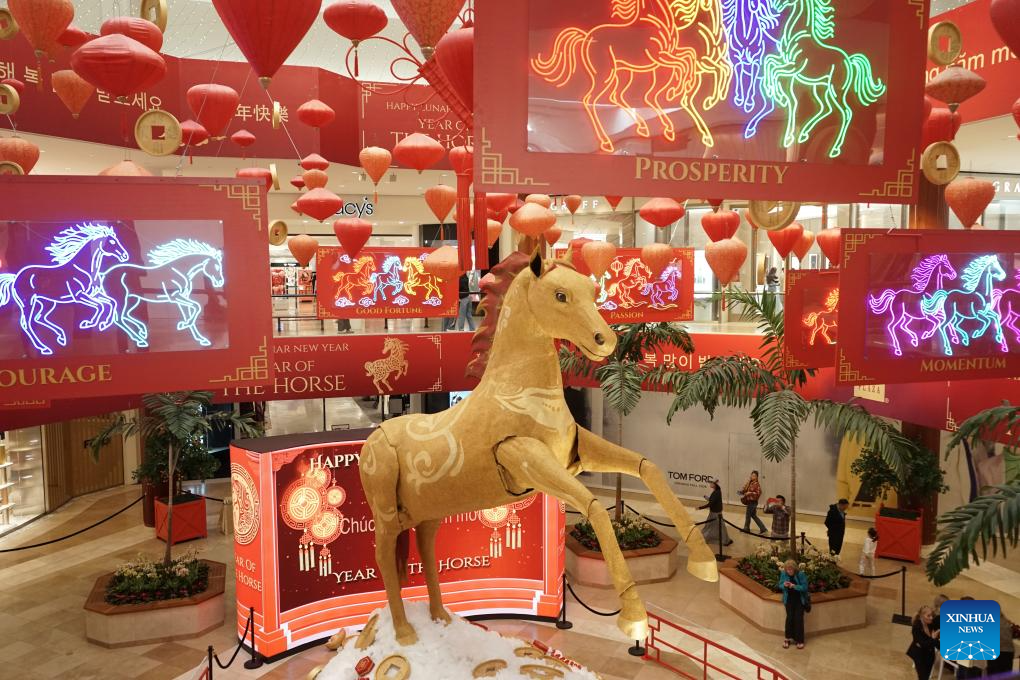
Luxury brands are treating Lunar New Year as a high-stakes moment to re-engage Chinese shoppers, rolling out limited collections, festive campaigns, and in-person events aimed at restoring momentum in a market that has cooled sharply from its peak.
Ahead of the Year of the Horse, which begins Tuesday, brands have leaned into both scarcity and symbolism. Harry Winston introduced a limited-edition rose-gold watch priced at $81,500, featuring diamond detailing and a red lacquer horse. Chloé released a capsule range that runs from $250 silk scarves to a $5,300 snakeskin-and-leather shoulder bag featuring horse-inspired elements. Other houses, including Loewe, Gucci, and Loro Piana, have launched accessories such as bag charms with horse motifs, aiming to capture gift spending and holiday shopping in a short, highly concentrated window.
A market that is stabilizing, but tougher than before
The push comes as luxury executives look for signs that China’s designer market is bottoming out. Chinese consumers once drove a large share of global luxury demand, but spending has softened in recent years, pressured by slower economic growth, weaker housing values, and a more cautious mood among big-ticket buyers.
Estimates from Bain put China’s luxury market at roughly 350 billion RMB in 2024, about $50 billion. The firm has estimated the sector contracted by 3% to 5% in 2025, but also noted improvement in the second half of the year alongside firmer stock-market performance and a lift in confidence. Some analysts now expect spending to stabilize and return to modest growth in 2026, though the competitive intensity is far higher than when demand was roaring.
One reason is that Chinese luxury shoppers have changed. Before the pandemic, Chinese consumers accounted for around a third of global luxury goods demand, according to some estimates. That share has since dropped to the low 20% range. Even when buyers remain willing to spend, they are more selective, more experienced, and less easily impressed by branding alone.
Why Lunar New Year still matters
Lunar New Year is not the only driver of luxury demand, but it offers brands something increasingly valuable: cultural relevance. The holiday is closely associated with red and gold, colors linked to good luck and prosperity, and each year is tied to one of the 12 zodiac animals. That gives brands a familiar seasonal framework to build products, visuals, and storytelling around, while also creating a natural reason to refresh store displays and launch new marketing.
But the same framework can backfire if it comes across as lazy. Industry watchers increasingly argue that surface-level zodiac references, like predictable animal graphics or obvious red-and-gold palettes, can come across as formulaic. Younger shoppers in particular tend to respond better to designs that feel contemporary, thoughtful, and connected to a broader narrative rather than a literal holiday costume.
A key risk this year is overusing horse imagery. The zodiac animal is often considered especially auspicious for people born in that year, which means the symbolism is not necessarily universal. Brands that bet too heavily on the horse as a central design hook could end up narrowing the appeal of their collections.
The shift from products to experiences
As the market matures, brands are increasingly leaning on experiences to deepen engagement. That can mean pop-up exhibitions, festival-style activations, interactive installations, and location-based events designed for social sharing.
Recent examples show how this approach is evolving. Valentino staged a three-day lantern festival in January at Tianhou Palace, a historic temple site along Suzhou Creek in Shanghai. Burberry launched an extensive Lunar New Year campaign earlier in the season, featuring Chinese brand ambassadors and physical activations including a pop-up boutique and an ice rink in Beijing. These campaigns reflect a broader shift in luxury marketing: the goal is not only to sell a themed product, but also to create cultural credibility and emotional connection.
For brands, experiences can do something that product drops often cannot. They build local relevance, create high-quality content for social platforms, and offer younger consumers a reason to engage even if they are not ready to buy immediately.
A very different China from the early 2010s
Lunar New Year collections became common in the early 2010s, when Western brands were racing to capture a fast-growing base of newly wealthy buyers. Back then, access to luxury goods in China was more limited, especially outside top-tier cities, and many consumers did most of their high-end shopping abroad.
That pattern has changed. China now has far broader retail coverage and much more choice, and consumers have years of global travel and purchasing experience behind them. At the same time, pandemic-era travel restrictions reshaped habits. Bain estimated that about two-thirds of Chinese luxury spending occurred overseas in 2019, but by last year, overseas purchases accounted for only about one-third. Even as international travel continues to normalize, domestic buying is now a larger and more durable part of the mix.
This shift has two major implications. First, brands have to work harder inside China because they can no longer rely on offshore shopping in Europe or elsewhere to do the heavy lifting. Second, consumers have more exposure to alternatives, including increasingly confident domestic premium labels, which has reduced the automatic prestige once attached to Western luxury.
What wins now: taste, restraint, and real storytelling
The Year of the Horse gives brands a convenient entry point, but success is increasingly tied to execution. Many luxury shoppers are no longer persuaded by obvious holiday symbols alone. The brands most likely to gain traction are those that use the season as a creative prompt rather than a template, building designs that feel premium first and seasonal second, and backing product drops with campaigns that show genuine cultural fluency.
In short, Lunar New Year remains a powerful moment for luxury in China, but it is no longer easy. The prize is real: a chance to reconnect with high spenders, rebuild relevance, and signal that a brand understands modern Chinese consumers. The challenge is equally clear: the bar is higher, the audience is more discerning, and generic holiday marketing is less likely to move the needle.