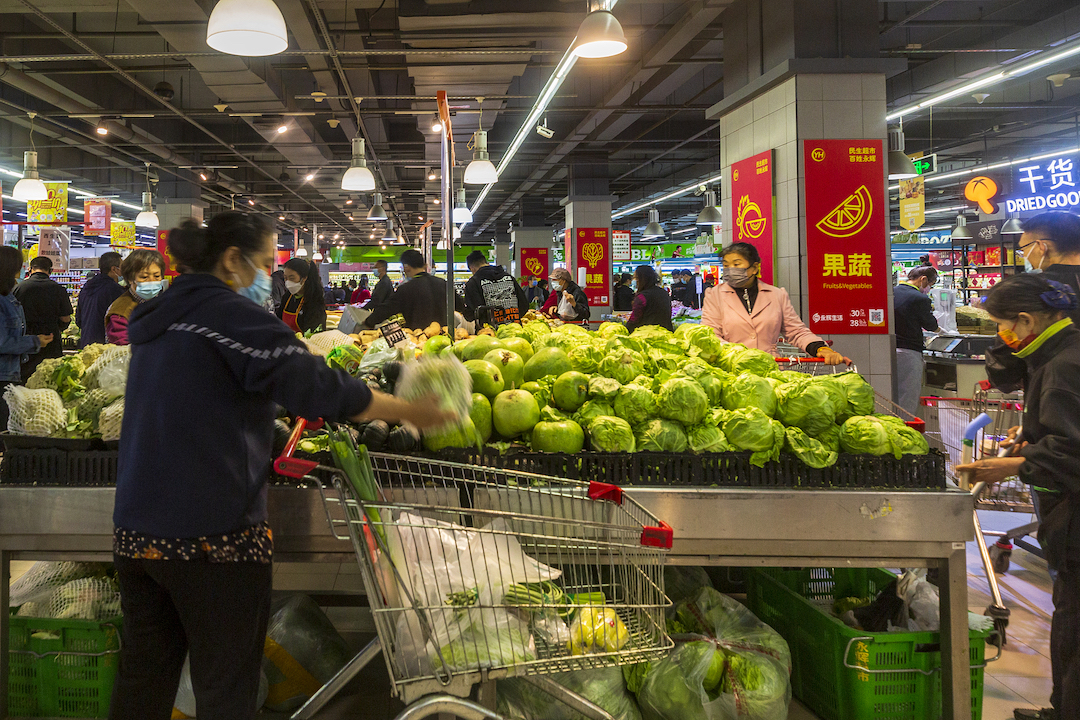
China’s economy lost momentum in the fourth quarter, with growth cooling to its slowest pace in almost three years as household demand softened and the property downturn continued to weigh on activity. The slowdown came even as full-year output met the official target, supported by resilient exports and a record trade surplus that helped offset weakness at home.
Official data showed gross domestic product expanded 4.5% in the fourth quarter, down from 4.8% in the prior quarter. It was the weakest quarterly reading since early 2023, highlighting how difficult it has been to generate a durable domestic recovery while dealing with excess capacity, weak pricing power, and a prolonged real-estate correction.
For 2025 as a whole, growth came in at 5%, broadly matching the government’s goal of around 5%. That outcome suggests policy support and external demand provided enough lift to keep headline growth on track, even as underlying conditions remained uneven across consumption, investment, and parts of the labor market.
December indicators point to a consumption gap
Separate December figures underscored the imbalance. Retail sales rose 0.9% year on year, undershooting expectations of 1.2% and slowing from 1.3% in November. The reading marked the softest retail-sales growth since late 2022, reinforcing the view that households remain cautious and that the recovery in spending has not gained consistent traction.
Industrial production, by contrast, was somewhat stronger. Output rose 5.2% in December, above expectations for 5% and up from 4.8% a month earlier. The pickup suggests manufacturing activity has stabilized, supported in part by external demand and supply-side strength, even as domestic consumption remains a drag.
Investment continued to signal pressure. Fixed-asset investment, which includes infrastructure, manufacturing, and property, contracted 3.8% in 2025, worse than expectations for a 3% decline. Real estate development investment fell 17.2% over the year, deepening from a 10.6% decline in 2024. The persistence and scale of the deterioration highlight how the property sector remains a central headwind, affecting upstream industries, local government finances, and household balance sheets.
The surveyed urban unemployment rate held steady at 5.1% in December. While stable on the surface, labor-market uncertainty remains a key constraint on spending, particularly among younger workers, and continues to reinforce precautionary saving behavior.
Growth support is coming disproportionately from trade
A key theme in the 2025 data is the economy’s increasing reliance on external demand. China reported a record trade surplus of nearly $1.2 trillion last year, driven by strong shipments to markets outside the United States as exporters redirected flows and diversified destinations. That export strength allowed policymakers to delay large-scale stimulus, relying instead on more targeted support as long as headline growth remained near target.
Officials indicated that net exports accounted for close to one-third of GDP in 2025, while consumption contributed 52% of output. The composition points to a structural challenge: if consumption is contributing just over half of growth while net exports are doing an unusually large share of the lifting, the economy becomes more exposed to external policy shocks and global demand cycles.
Trade risks are still significant. The U.S. administration has signaled that additional tariff measures could be considered in connection with geopolitical issues, and a temporary easing in bilateral trade tensions is set to expire later this year. At the same time, the size of China’s trade surplus has intensified criticism from multiple trading partners, raising the risk of new barriers designed to protect domestic industries from an influx of lower-priced imports.
Many economists argue that this model is not sustainable over the long run. With investment weakening and household consumption subdued, exports have become the default stabilizer. That can keep headline growth afloat, but it also increases the probability of pushback abroad while leaving domestic demand fragile.
Deflation signals remain hard to ignore
Price data continues to send mixed but concerning messages. Consumer inflation accelerated to 0.8% in December, the fastest pace in nearly three years, yet producer prices fell 1.9%, extending factory-gate deflation. More broadly, the GDP deflator, a comprehensive measure of prices across goods and services, has remained negative since 2023, a sign that weak demand and excess supply are still suppressing pricing power across the economy.
The policy challenge is that mild consumer inflation does not necessarily imply improving demand when producer prices and broader price measures remain under pressure. In that environment, firms face margin compression, wage growth tends to stay constrained, and households have fewer reasons to feel confident about spending.
Credit trends underline that caution. New bank lending fell to a seven-year low of 16.27 trillion yuan (about $2.33 trillion) in 2025, indicating weak borrowing appetite and subdued private-sector risk-taking. That puts more weight on policy tools to prevent a slow drift into deeper deflation and weaker confidence.
Policy easing is expanding, but expectations are rising
The central bank has recently announced a package of credit-easing measures, including a 25-basis-point rate cut across several lending facilities and higher quotas for programs aimed at priority areas such as agriculture, technology, and private enterprise. The intent is to lower funding costs, support targeted credit creation, and reduce pressure on sectors that are struggling to access financing.
Markets and analysts broadly expect additional easing early in 2026, including further reductions to the reserve-requirement ratio and modest cuts to the policy rate. The debate is less about whether more support is coming and more about whether incremental steps will be sufficient to change behavior. Many observers argue that without clearer improvements in employment prospects, income growth, and private-sector confidence, households may continue to save rather than spend, and firms may remain reluctant to expand investment.
The bottom line
The fourth-quarter slowdown to 4.5% shows that meeting an annual growth target does not necessarily signal a healthy internal engine. Exports and external demand have borne a large share of the burden, while consumption remains soft and the real estate downturn continues to depress investment. With deflation signals still visible in producer prices and broader economy-wide measures, the policy priority for 2026 will be converting targeted easing into a more convincing rebound in domestic demand, credit appetite, and private-sector confidence.